

The physiotherapy timeline — what to expect, step by step
Clear milestones, realistic timings, and exactly what we do at each visit so you arrive prepared and confident.
Our clinical loop — Assess, Treat, Monitor — repeated until goals are met.





Discovery Call — up to 30 minutes to confirm needs, logistics, and fit; interview your physiotherapist and choose who you want to work with.
Intake & Prep — brief forms and space check; confirm options (early/late, travel eligibility).
Assessment Session — full clinical assessment to establish problems, contra‑indications, and the data we will track.
Treatment Session(s) — focused exercise‑forward sessions with hands‑on techniques as needed; session content evolves from assessment findings.
Post‑session follow‑up & Rehab Blueprint — Hotel Card delivered after assessment; updated blueprint and video cues after treatment; ongoing monitoring and re‑assessment as needed.
Delivery tiers — how we show up for you
Tier 1 — Single on-site assessment
What it is — A focused 55 minute in‑person assessment
When to use — One‑off checks, acute problems, visiting athletes, or a targeted return‑to‑activity question.
Booking rule — Sessions are sold and scheduled one at a time; follow‑up timing is recommended after the assessment and booked individually.
Link — Use the session estimator to preview single‑visit cost and travel eligibility. Early AM or Late PM available for an additional fee; select your preference in the Estimator.
Tier 2 - Travel and full‑service day
What it is — A single booking that reserves clinician time for a half‑day or full‑day on‑site visit
When to use — Executives, travelers, or single‑clinician on‑site visits where you need consolidated access to clinic‑grade testing.
Booking rule — This remains a single session purchase that reserves clinician time for the half‑day or full‑day window; it does not convert into multiple separately bookable sessions. It does not imply unlimited coverage.
Link — See travel eligibility and logistics (coming soon)
Tier 3 - Private Athlete Service with bespoke cadences
What it is — Season‑aligned visit rhythms, objective baseline snapshots, and post training session rehab designed for training load and readiness management. Includes Rehab Blueprints and performance‑focused metrics.
When to use — Athletes and coaches who need timely, metrics‑driven decisions across a season.
Booking rule — Initial session is booked individually and informs a bespoke cadence; ongoing visits are then scheduled one at a time based on that clinical plan.
Link — Explore Private Athlete packages and sample cadences
Sessions are sold and scheduled individually. Travel bookings reserve clinician time for a half‑day or full‑day window for one client only; multi‑athlete or team coverage requires a bespoke quote via Private Athlete services.
Run the Estimator to check single‑session pricing, preferred time windows (early AM / late PM), and whether travel converts the booking to a half‑day or full‑day rate
We cannot commit to follow-up sessions until after the first assessment to ensure physiotherapy remains appropriate after your first session; you may book as many follow‑ups as needed, one at a time so long as your physio deems your condition appropriate.
Session structure — two distinct session types
Overview
We separate Assessment Sessions (first visit) from Treatment Sessions (follow‑ups). Assessment Sessions gather the full clinical picture and set the Rehab Blueprint & Hotel Card. Treatment Sessions always start with a brief re‑assessment of key measures and then focus on exercise‑forward treatment with hands‑on techniques as needed.
Assessment Session — typical structure and timing
Subjective history and goals — 15–20 minutes We collect medical history, injury story, activity demands, lifestyle factors, medications, prior treatments, and your short/long‑term goals.
Objective exam & baseline measures — 15–25 minutes Targeted hands‑on exam plus objective tests (strength, ROM, functional checks). We use VALD Dynamo and practical functional tasks where indicated.
First‑step intervention & education — 10–20 minutes Short, practical exercises, symptom‑management techniques, and education to empower immediate progress and safety.
Handover & next steps — 5 minutes What to expect next, scheduling, and that we’ll deliver your Rehab Blueprint (Hotel Card) within ~72 hours.
Typical Assessment Session: 55 minutes depending on complexity; some clients may require a 2nd assessment based on their specific clinical presentation
Always re‑assessing, always proving progress
We re‑assess you every visit — not just by feel, but with targeted, repeatable measures so you can see objective change over time. We record baseline and follow‑up metrics, track Hotel Card adherence, and translate that data into clear decisions about progression, return‑to‑sport, or escalation. This is how we prove value and keep you moving forward.
Want measurable rehab? Book a Discovery Call
Treatment Session — typical structure and timing
Brief re‑assessment — 5–10 minutes We start with an oral progress update, asking you about how you’ve been doing since our last check in, from there we move to a focused re‑check of 1–3 key measures from the assessment (strength spot‑checks, ROM, symptom tolerance) to document change and guide loading and progress. Know that we will always check in on you between sessions too - does your physio do the same?
Exercise‑forward treatment & coaching — 30–40 minutes Progressive exercise prescription, movement retraining, motor control work, load management, and performance progressions. Specific coaching examples: tempo control, eccentric loading, progressive plyometrics, sport‑specific transfer drills.
Supplemental hands‑on and modalities — 5–15 minutes Manual therapy, soft tissue work, acupuncture/dry needling, or taping used only to enable exercise and reduce symptom barriers.
Handover & adjustments — 5 minutes Brief summary, homework, and any Hotel Card updates noted for the at‑home plan.
Typical Treatment Session length: 55 minutes; content and time allocation vary by case.
The Detailed 5-step process:
A clinician‑led sequence from first contact through measurable recovery so you know exactly what will happen and when.
-

Discovery Call — 30 minutes
Purpose: a short 15–30 minute call to confirm clinical fit, logistics, and expectations — and for you to interview your physiotherapist.
What you do on the call: meet your clinician, describe your concern, ask about clinical approach and availability, and confirm next steps.
Unlike many clinics where admin staff assign a clinician, you hire the physiotherapist you want — the Discovery Call is your opportunity to choose.
-

Intake & Prep
collect consent, background forms, and confirm the physical space and equipment needs.
Typical time commitment (client): 5–10 minutes online pre‑visit. Can be done at the end of your discovery call.
What we capture: imaging/referrals, space confirmation ~180 cm × 180 cm plus a bench/table.
-

Assessment Session — what it is and why it matters
The Assessment Session is a full clinical evaluation performed in‑person or virtually as indicated. We take your history, conduct a hands‑on clinical exam, and run targeted baseline tests (strength, ROM, and functional checks) to understand the problem and identify safe, effective interventions.
This is not a generic “fill in the blanks” process — it’s the clinical assessment everyone receives before any treatment or program is prescribed. Typical length: 45–55 minutes.
What we document: medical and injury history; red flags; joint and soft tissue exam; targeted strength/ROM measures using objective tools where indicated; functional task observations; initial clinical impression and plan.
-

Treatment Session — exercise‑forward care with hands‑on where needed
Treatment Sessions are distinct visits focused on active rehabilitation. Our philosophy is exercise‑first: sessions prioritise progressive exercise, movement retraining, and coaching to restore function. Hands‑on techniques, needling, or manual therapy are used supplementally when clinically indicated to enable exercise and reduce symptom barriers. Typical length: 45–55 minutes.
Examples of exercise coaching we provide: load prescription, movement cueing, progressive strength sets, tempo control, eccentric loading, plyometric progressions, motor control drills, breathing strategies, and sport‑specific transfer work.
Education examples included in sessions: condition explanation, pain neuroscience basics where appropriate, safe progression rules, how to integrate rehab around work/travel, activity modification, return‑to‑sport/work guidance, and when to seek re‑assessment.
-

Post‑session follow‑up & your Rehab Blueprint
After the Assessment Session we create your Rehab Blueprint — a Hotel Card containing short, personalized exercise videos and priority cues that show you exactly what to do between visits. Expect delivery during your assessment session or within 72 hours if virtual.
After Treatment Sessions we update your Rehab Blueprint so the Hotel Card always reflects your current priorities and progress. The Hotel Card is the single source of truth for at‑home work and is measurable, simple, and specific.
We monitor objective metrics and symptoms between sessions and schedule formal re‑assessments when progress stalls or milestones are reached. Monitoring includes periodic repeat strength and functional tests, pain and tolerance checks, and Hotel Card compliance reviews so we can adapt the rehab plan responsibly and efficiently.
Why clinician choice and repeatable measurement matter
Choose your physiotherapist, prove progress with objective measures, and follow a clinician‑filmed Rehab Blueprint that keeps care consistent and actionable. Summit closes the common tradeoffs in other care models by offering clinician choice, one‑clinician continuity, clinic‑grade objective measurement, and clinician‑filmed Rehab Blueprints that clients can follow immediately.
Your rehab session on your schedule
One clinician owns care
Objective measures every visit
Clear clinician‑filmed take‑homes
“Coming soon”
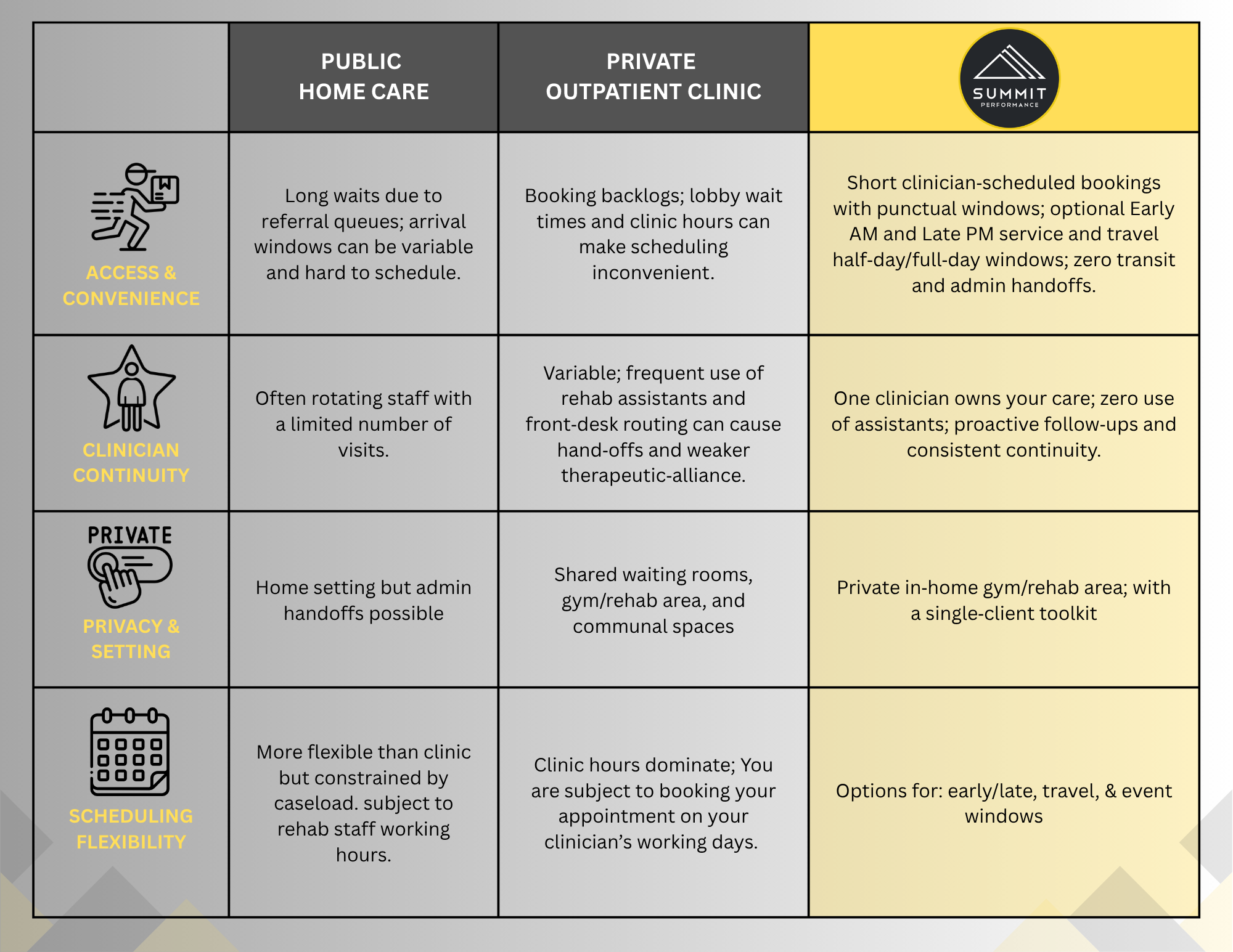

Want the evidence, examples, and short case stories that back these claims? Explore the deeper comparisons here
Typical 90-day rehab arcs
Real clients follow real timelines — examples of how common injuries and performance needs typically progress so you know what to expect. We show these arcs to set realistic expectations, highlight the metrics we track, and illustrate why frequent re‑assessment and measurable Hotel Cards matter.
Each injury and client is unique. Below are three typical 90‑day pathways we see most often; they show common milestones, the objective metrics we monitor to guide decisions, and a realistic cadence of visits. We use our clinical discretion to modify each client’s individual care plan. These samples demonstrate some of what we CAN do in guiding care, but not necessarily exactly what we would do for your specific case.
Looking to see how we would help you specifically? book a discovery call to get started.
Chronic Low Back Pain
pain control to load‑tolerant strength
Sample/Mock Client
70 year old executive with low back pain and osteoarthritis. Uncomfortable during the day but manages day to day tasks at work and home, recommended to see a physiotherapist so he can decrease pain and get exercise recommendations to integrate into daily life
Quick timeline:
Weeks 0–2: pain control + mobility;
Weeks 3–6: progressive load tolerance;
Weeks 7–12: return‑to‑work/sport conditioning.
Primary Metrics we Track
pain scores; lumbar ROM; timed loaded carry or squat tolerance; VALD strength spots when relevant.
Typical Session Cadence
Assessment (55 min); 1–2 treatments/week for 2–6 weeks; re‑assess at 6 weeks then at 12 weeks.
Expected 90-day Outcome
Improved pain control, measurable strength and ROM gains, and progressive return to full activity.
Concussion (Post Sports injury)
graded cognitive and physical return.
Sample/Mock Client
high school multi-sport team athlete, hit his head on the field playing football during a tackle. doctor advised proceed with concussion protocol and see a physiotherapist for rehab and return to sport.
Quick Timeline
Weeks 0–1: symptom management + vestibular/cervical screen
Weeks 2–6: graded exertion and vestibular rehab
Weeks 7–12: sport integration and clearance
Primary metrics we track:
symptom provocation;
vestibular tolerance tests;
cervical ROM and load tolerance
functional exertion benchmarks.
Session cadence:
Initial assessment (done in 2 blocks of 55min)
weekly check‑ins;
staged exertion testing;
re‑assess at symptom resolution and at 6–12 weeks.
90‑day outcome:
Controlled symptom tolerance for school, life, and sport
graded return to sport drills,
objective clearance markers & functional exercise re-tests
Sport Performance Check-ins
monthly strength and function monitoring.
Sample/Mock Client:
independent “weekend warrior” with a committed independent 5x weekly strength & conditioning routine. Looking to work with a physiotherapist for regular check ins and performance metric collection in pursuit of his own optimization with independent strength training.
Quick Timeline
Month 0: baseline battery;
Month 1–3: monthly metric updates and targeted sessions.
Primary metrics we track:
VALD strength peaks;
single‑leg power tests;
movement quality and sport‑specific function
muscle sequencing and mind muscle connection improvements for core lifting movements
Session cadence:
Baseline assessment,
monthly check‑ins and re-assessments,
ad‑hoc treatment sessions as needed for injury management
90‑day outcome:
Monthly measurable improvements and targeted updates to your Rehab Blueprint (Hotel Card).
This is an athlete use case — see our private athlete service and sample cadences here
Want a rehab plan that’s measurable and customised? Book a Discovery Call and we’ll place your case on the right track.
Practical Checklists & Visit Prep
What to prepare for your in-home visit
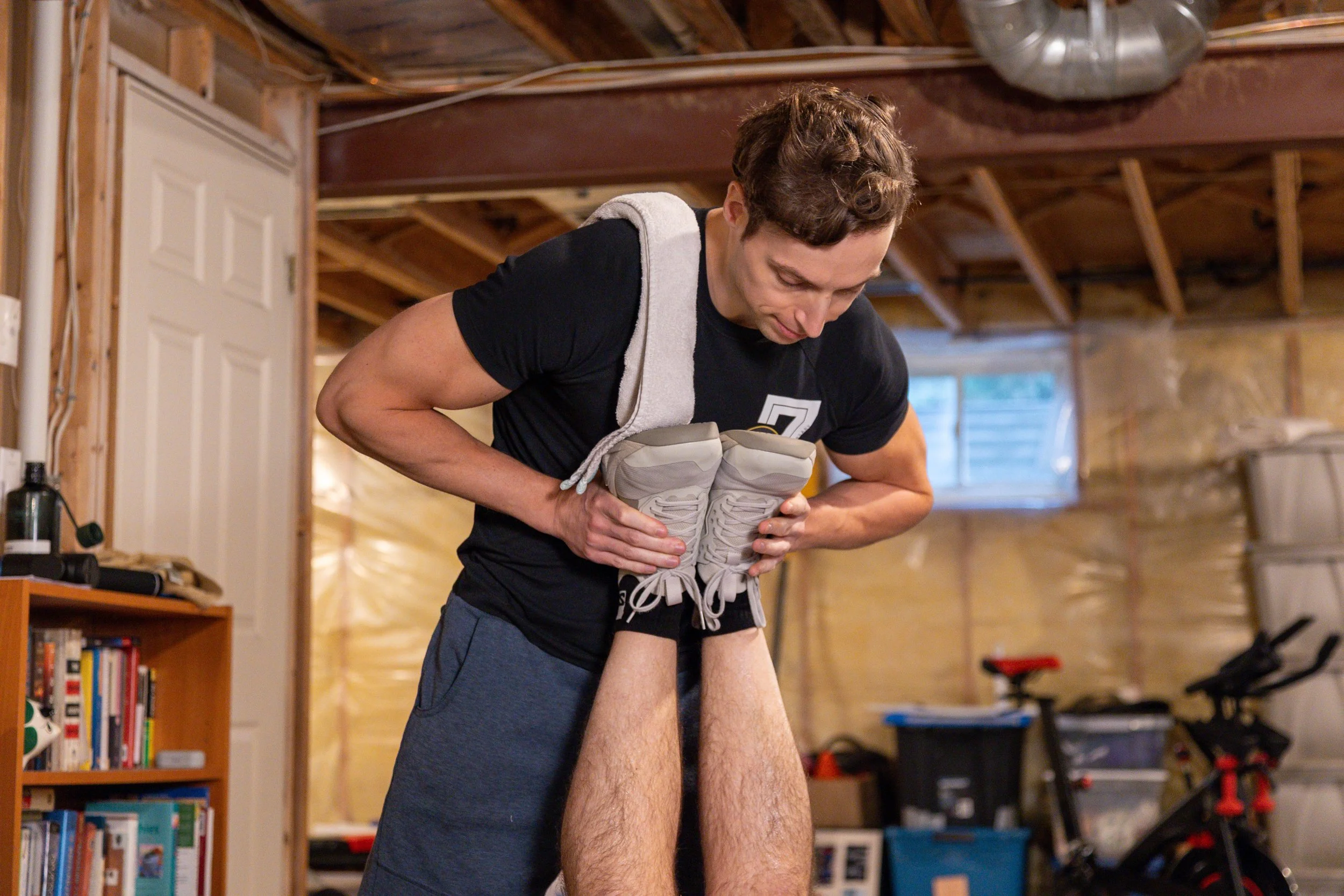
Space: Clear roughly 180 cm × 180 cm of floor space.
Surface: Have a sturdy surface to lie on (bench, firm table) and a chair available.
Clothing: Wear comfortable, movement‑friendly clothing that allows joint inspection and testing.
Documents: Bring recent imaging, reports, or referral notes if available.
Tech: Keep a phone or tablet nearby for reference to your Hotel Card; ensure a quiet spot for video capture if needed.
In advance of your session its great to have
photos of your home space we will be working in. You an also show us on video during your discovery call so we can walkthrough any issues or questions together
upload any documentation (medical referrals or imaging, training programs, etc.) using our inquiry form, or email them to us if you’d like us to review before your session.
Preparing this simple space helps us complete a safe, accurate assessment and produces usable Hotel Card footage.
What we bring and what we don’t
What we bring
Clinic‑grade tools that make sessions objective and actionable: simple strength and ROM checks, filmed take‑homes, and digital baselines that speed decision making. See full kit and measurement protocols
What we don’t bring
Heavy clinic machinery or shared gym machines.
Items that require a third‑party venue or fixed equipment (e.g., large hydraulic machines).
Shared equipment usage expectations; we operate single‑client kits to avoid cross‑contamination and scheduling delays.

Booking and logistics — how bookings work
Booking flow and discovery call (no online checkout)
We do not offer online instant booking. The first step is a ~30 minute Discovery Call to confirm fit, logistics, and travel eligibility.
After the Discovery Call you may book a single assessment (55 minutes). All sessions are sold and scheduled one at a time; follow‑ups are recommended after assessment and booked individually.
To start: Run the Session Estimator to preview single‑session pricing and time‑window surcharges, then book a Discovery Call to confirm availability and next steps
Time‑window options and pricing
We offer optional preferred time windows for single sessions: Early AM (before 6:00) and Late PM (after 22:00). Choosing a preferred window will incur an additional fee to cover clinician availability and travel logistics.
Use the Session Estimator to preview single‑session pricing with your preferred window selected; the Estimator will also show when travel eligibility converts a booking into a reserved half‑day or full‑day rate.
How to request: Select Early AM or Late PM when using the Estimator or note your preference during the Discovery call; availability is confirmed at booking.
Travel bookings: reserving a half‑day or full‑day window guarantees clinician availability for one client during that reserved window; the same time‑window upcharge rules apply if you request specific early or late start times. Travel service days do not convert into multiple independent session.
Teams and multi‑athlete coverage require a bespoke quote via the Private Athlete / Events inquiry flow and are not covered by single‑session time‑window options.
Cancellation and rescheduling
We follow the same cancellation and rescheduling policy as our Personal Training services; please see the full policy here
Questions about scheduling or travel feasibility? Book a Discovery Call or Check Travel Eligibility.
Still have questions? Check out our Physiotherapy FAQ’s